SATIRE · NATIONAL | All characters, quotations, and proposed responses below are fictional.
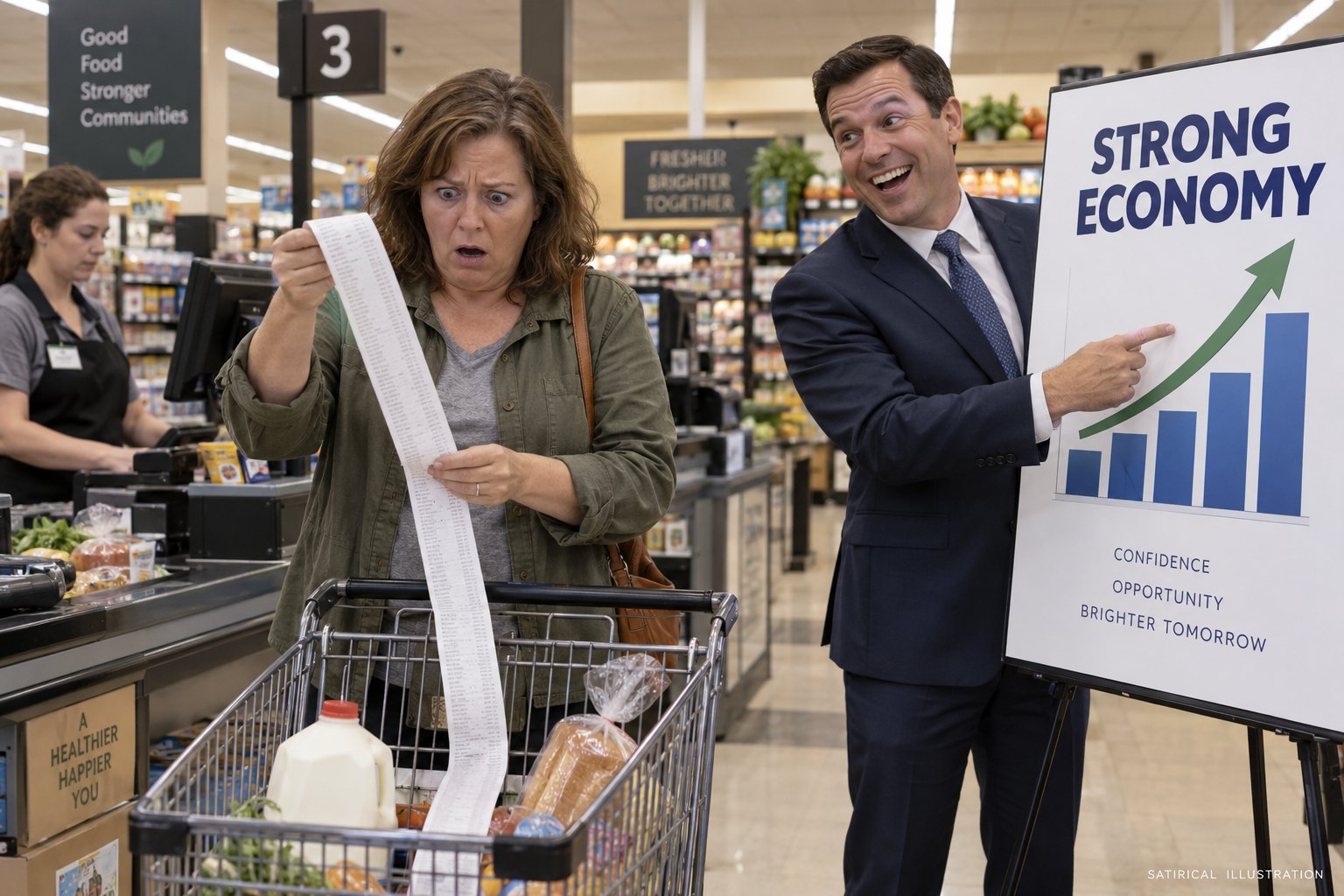
Satirical illustration — fictional scene, not a news photograph.
WASHINGTON — After another drop in consumer sentiment, The Daily Holler’s imaginary economic advisers identified the problem: Americans keep checking what things cost.
The discovery came after a fictional shopper committed the reckless act of buying groceries, reading the total, and comparing it with the money she actually had.
‘You can’t judge the economy by your own personal experience of participating in it,’ explained an invented spokesperson. ‘You have to look at the bigger picture. Preferably from a yacht.’
The real backdrop: Reuters reported October 9 that the University of Michigan’s consumer sentiment index fell for a third straight month, from 48.1 in September to a preliminary 46.3 in October. Its reporting also described higher-income households driving much of consumer spending while other household budgets remained under strain.
Our fictional advisers described this as encouraging news for anyone fortunate enough to be the other household.
A receipt is just a pessimistic spreadsheet
To restore confidence, the imaginary communications team recommended replacing itemized receipts with a short message reading YOU ARE PARTICIPATING IN A RESILIENT ECONOMY.
‘People see a total and immediately become negative,’ the spokesperson said. ‘But if we remove the total, all that’s left is opportunity.’
Asked how customers would know whether they could afford their groceries, he suggested contacting their financial adviser.
One shopper explained that her financial adviser was a calculator with a cracked screen.
‘Excellent,’ he replied. ‘Small business innovation.’
For shoppers still experiencing financial distress, the fictional team recommended standing farther from the register until the number appeared smaller.
Have you tried being the upper part of the economy?
The imaginary briefing also introduced a practical household budgeting technique: check a richer person’s bank account instead.
‘Consumer spending remains strong,’ said a fictional analyst. ‘Someone is buying things. Have you considered being that someone?’
A father said he had considered it extensively, usually while deciding which bill could survive another week on the kitchen counter.
The analyst recommended diversifying his income.
The father explained that he already had a job, a second job, and a collection of passwords for delivery apps.
‘Wonderful. Your household has become a portfolio.’
He then suggested building an emergency fund. The father pointed to his grocery cart and explained that the emergency had already spent it.
Optimism now available in convenient monthly payments
Under our completely fictional new confidence initiative, Americans would receive a motivational email each time a bill arrived.
An electricity bill would be accompanied by YOU’RE POWERING GROWTH. A car payment would say KEEP MOVING FORWARD. A declined card would trigger YOUR JOURNEY IS STILL PROCESSING.
The emails would be free, making them the first thing in the household budget nobody needed to put back.
A fictional mother asked whether optimism could be used at the gas pump.
The spokesperson said confidence was priceless.
‘That’s convenient,’ she replied. ‘Everything else sure as hell isn’t.’
At imaginary press time, the advisers announced that public morale had improved significantly after they stopped asking people who were paying bills.
The shopper returned to the checkout with milk, bread, and a renewed appreciation for national economic resilience.
The cashier asked whether she wanted cash back.
‘Yes,’ she said. ‘All of it.’
EDITOR’S NOTE: This is satire inspired by the October 9, 2026 Reuters report linked below. The invented advice, officials, shoppers, and programs are jokes, not actual government announcements. Consumer sentiment measures attitudes; it is not a direct measure of the entire economy.
Real-news source: Reuters’ October 9, 2026 consumer-sentiment report, verified October 10, 2026.
More national satire: Microsoft receives mixed messages from Washington